Collaboration between Institut Pasteur & Singapour A*STAR ID Labs

A partnership rooted in the Asia-Pacific region
Two themed workshops were jointly organized to nurture the budding partnership: one at the Institut Pasteur in Paris in October 2023 and the other at A*STAR in Singapore in November 2024, attended by representatives of Pasteur Network member institutes from the Asia-Pacific region. This provided an opportunity for scientists from both institutions to discuss their current work in three key research areas: respiratory diseases, vector-borne diseases and antimicrobial resistance.

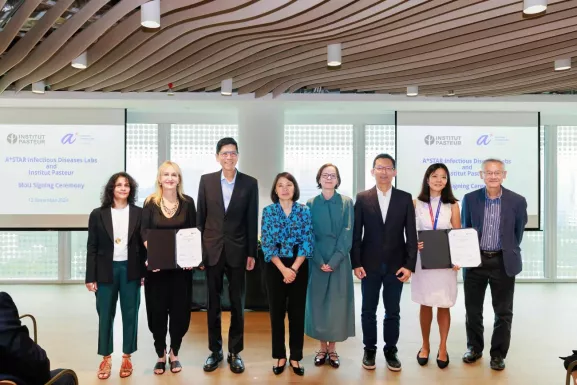
Building on this initial impetus, the two organizations decided to establish a formal framework for their collective efforts. In November 2024, a memorandum of understanding was signed, laying the foundations for enhanced cooperation in collaborative research and joint development of innovative technologies in the field of infectious diseases. Several months later, in April 2025, a Master Research Collaborative Agreement was signed during a visit by the Deputy Prime Minister of Singapore and the progress meeting of the France-Singapore Joint Committee on Science and Innovation (COSIMIX). This second agreement honed in on two priority areas for research collaboration: aging and the immune system, and the microbiome.
The long-term goal of these moves to create synergies between the two organizations is to promote research partnerships with other Pasteur Network members in the region. Due to its location in Singapore, at the heart of a geographic area particularly exposed to infectious disease outbreaks, A*STAR ID Labs offers an ideal focal point around which to unite the Pasteur Network's forces at regional level.
Two pilot research projects in key areas
Two research projects have already emerged under this partnership:
The "Bidirectional effects of infection on lifespan biology" project:
This study seeks to identify senescence biomarkers to prevent biological aging, develop therapeutic responses and, in the longer term, adopt an approach based on personalized medicine to reduce the impact of infection-related aging on the population.
The "Microbiome Equilibrium: Linking Lung-Gut Health to Chronic Disease" project: This study seeks to identify bacteria and fungal genes involved in the development and progression of chronic diseases of the lungs and stomach with a view to developing therapeutic responses based on microbiome function.
These two pilot projects are merely the start of something bigger.
In the long term, there is a clear ambition to promote this collaboration throughout the Pasteur Network in the Asia-Pacific region and jointly develop scientific responses to future health challenges.