Mouse genetics for disease modelling

Practical Information
- 5 weeks
- January 4, 2027 - February 12, 2027
-
Institut Pasteur
- English
Contacts
Registration
Accreditations:
- University Diploma (DU) - Université Paris Cité
- Université Paris Cité – G.E.N.E Graduate School
- Credits for Université Paris Cité Master 2 degree
- Credits for Sorbonne University Master 2 degree
- Credits for Paris-Saclay Master 2 degree
- Doctoral School Module
- Institut Pasteur Diploma
Description
Master 2 students from partner Universities (Sorbonne University, University of Paris Cité and Paris-Saclay University) MUST NOT register online and must submit their registration request DIRECTLY to contacts in charge of their university course. These students have free access to the course.
All other students must register online and pay their registration fees.
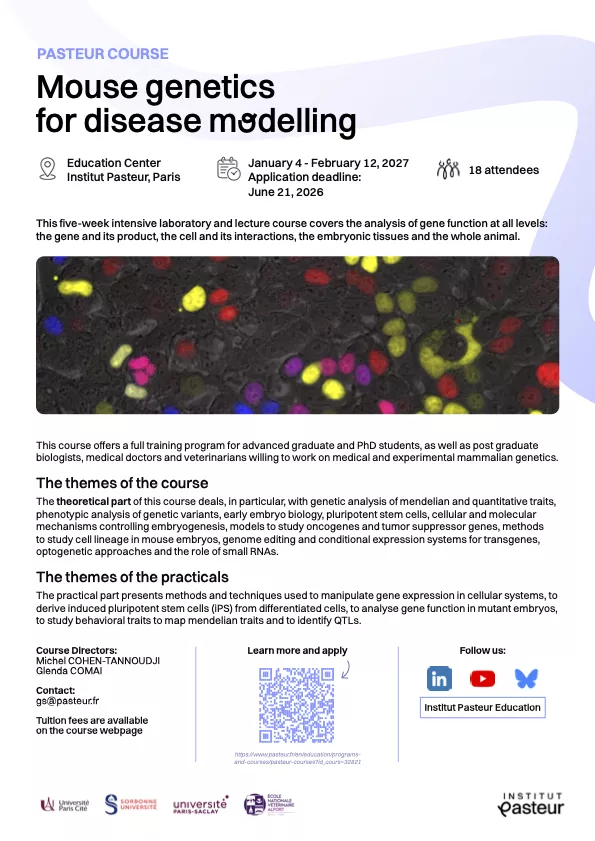
This course offers a full training program for advanced graduate and PhD students, as well as post graduate biologists and medical doctors willing to work on medical and experimental Mammalian Genetics.
The themes of the course:
The theoretical part of this course deals, in particular, with genetic analysis of mendelian and quantitative traits, phenotypic analysis of genetic variants, early embryo biology, pluripotent stem cells, cellular and molecular mechanisms controlling embryogenesis, models to study oncogenes and tumor suppressor genes, methods to study cell lineage in mouse embryos, genome editing and conditional expression systems for transgenes, optogenetic approaches and the role of small RNAs.
The practical part presents methods and techniques used to derive induced pluripotent stem cells (iPS) from differentiated cells, to study behavioral traits, to analyze gene function in embryonic and adult mutants, to map mendelian traits of Masters, and to identify QTLs. It also illustrates the use of RNA interference to silence gene expression.
Student opinion on the Mouse Genetics Course
According to recent opinion surveys, 100% of the students felt that the course fulfilled their expectation, covers the topic, and offers very good or excellent lectures. The general organization and the program were qualified as very good or excellent by all attendees. From free comments: "Effective teaching through an exchange with the students by an active teaching staff. All this orchestrated by very receptive and well recognized experts", "I really enjoyed the course despite the very busy days of study", "A very big thank for this incredibly rich training", "I really appreciated the quality of lectures and practical trainings. I will recommend this course to other students".
Candidates must have a good knowledge of basic laboratory techniques of Masters degree level. The course committee will evaluate applications.
Video
Course presentation for first-year master’s students in February 2026 :

Directors
COHEN-TANNOUDJI Michel - Institut Pasteur
COMAI Glenda - Institut Pasteur
Head of laboratory practicals
MANET Caroline - Institut Pasteur
Members of the course committee
ARTUS Jérôme * - Université Paris-Saclay
CHERIET Samia - Institut Pasteur
COHEN-TANNOUDJI Michel - Institut Pasteur
COMAI Glenda - Institut Pasteur
LALOUETTE Alexis - Université Paris Cité
MANET Caroline - Institut Pasteur
PACES-FESSY Mélanie - Sorbonne Université
PONTICELLI Virginie - Institut Pasteur
SALA Monica - Institut Pasteur
TIRET Laurent - Ecole Nationale Vétérinaire d'Alfort
TOLEDO Franck * - Sorbonne Université, Paris
* Representative of Universities
- Passport Photo
- CV with Publication List
- Motivation Letter (only for General Profile)
- Photocopy CNI or Passport or Residence Permit