4 min read
Technology at the core of our research
Modern biology is taking giant strides forward, supported by ever more powerful tools. 32 platforms and core facilities at the Institut Pasteur offer state-of-the-art equipment (atomic microscopy, genomic sequencing, microbial biobanking, etc.) allowing scientists to explore the living world as never before, open up new scientific horizons, and meet key global health challenges.
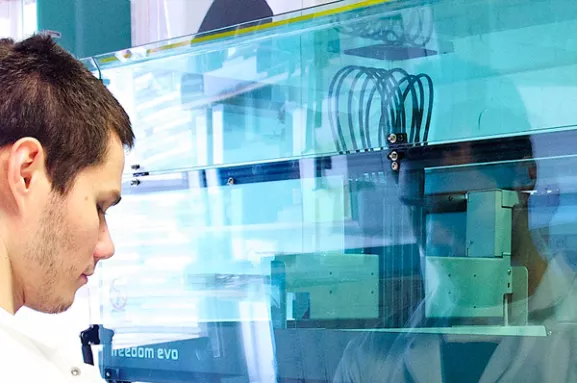
A cutting-edge technological environment
The Institut Pasteur's technological ecosystem offers scientists access to high-level tools and expertise meeting the most demanding international standards.
Our 32 platforms and core facilities are hubs of specialized equipment and services, strengthening our position as a global leader in biomedical research. We promote innovative technologies as a driver of scientific excellence in the key areas of computational biology, quantitative biology, artificial intelligence and data science.
Seeing the invisible: ultra-high-resolution imaging and microscopy
In order to understand a virus or protein, it needs to be observed at an extremely detailed level.
The Institut Pasteur has one of the world's most powerful cryo-electron microscopes, the Titan Krios. This technology allows microbes or molecules to be "fixed" at very low temperatures and viewed at atomic resolution. Pathogens of critical importance to human health can therefore be viewed in detail.
The Titan Krios microscope played a key role during the COVID-19 pandemic, leading to an improved understanding of the SARS-CoV-2 structure and contributing to research on future vaccines and treatments.
Artificial intelligence and computational biology: a new era in medical research
The Institut Pasteur is investing heavily in artificial intelligence (training, recruitment, infrastructure) to make it a key driver of research.
AI is used to enhance work carried out in almost all our laboratories, from image analysis to structural biology and mathematical modeling.
Specific projects are under way, including one on creating "virtual bacteria" (by developing digital twins of pathogenic bacteria) able to predict pathogen behavior. These AI models are capable of integrating molecular and functional information at several scales to simulate bacterial behavior and generate testable predictions.
The Institut Pasteur's Bioinformatics and Biostatistics Hub has played a pioneering role in biological data science since 2014, now employing over 70 highly qualified engineers and research engineers to analyze data at large scale and model the living world.
We also collaborate with centers of excellence in computational biology and artificial intelligence, including the major national consortium PR[AI]RIE – Paris School of AI, of which the Institut Pasteur is a founding member.
Our aim is to push the boundaries of computer analysis to help decipher complex biological processes and develop a better understanding of diseases.
Through its generation of unique data and advanced expertise in machine learning, the Institut Pasteur remains at the cutting-edge of applied biology and artificial intelligence in medicine.
Organoids: miniature organs helping us better understand diseases
Organoids are essentially miniature organs (gut, brain, lungs) cultured in a laboratory from human cells. These miniature 3D models of human organs replicate certain bodily functions, allowing scientists to perform experiments in conditions very similar to those seen in the human body.
The artificial biological models are used at the Institut Pasteur to improve our understanding of the mechanisms of certain brain infections or diseases and offer an alternative to animal models.
World-unique biobanks
Drawing on its unique history dating back to 1888, the Institut Pasteur keeps expansive biological collections in the strictest biosafety conditions, with over 200,000 unique specimens, including viruses, bacteria and parasites, some of which are historic and rare. The collections feature over 26,000 bacterial strains, including strains linked to antibiotic resistance that were isolated before 1970 and some even before 1950.
This irreplaceable scientific heritage allows us to study the evolution of infectious agents over time, improve our understanding of disease emergence, and explore novel therapeutic avenues including phage therapies.
We provide the international scientific community with access to these unique resources to enhance overall understanding of biodiversity and microbial evolution at global level.
Strategic technology partnerships driving innovation in healthcare
The Institut Pasteur works with top industry partners to co-develop technologies and speed up the conversion of discoveries into real-world applications. For instance, it is currently collaborating with L'Oreal on skin biology and new dermatological approaches and Leica Microsystems, a specialist in advanced observation technologies for life sciences.
These partnerships enhance our ability to develop artificial intelligence solutions in line with our Pasteur 2030 Strategic Plan, particularly in relation to the study of microbiomes, the mother-child relationship, and the origins of non-communicable diseases.
We need you!
Cutting-edge microscopes, nanoimaging, AI, organoids and state-of-the-art research equipment all come at a cost.
Together, let's give science the means to go further.